Senator Mayes Middleton’s SB 854 Bill is a Religious Freedom Protection Bill for Churches and Nonprofits, not for-profit “Sharia Cities”: A Legal and Policy Analysis
Introduction
Texas Values Action and its team have a combined 40+ years of experience on law and policy matters at the Texas Legislature, with specific emphasis on legislation related to religious freedom. Our President, Jonathan Saenz, has been a licensed attorney in Texas since 2003, and has been involved in every major religious freedom law passed in Texas since 2007. Jonathan Saenz has also focused his professional work in and around the Texas Legislative process and Texas Capitol previously for First Liberty Institute, and currently for Texas Values and Texas Values Action since 2013 and 2014 respectively. This is not the first time we have seen someone attempt to mischaracterize a religious freedom bill or issue in order to criticize a current candidate for elective office in Texas.
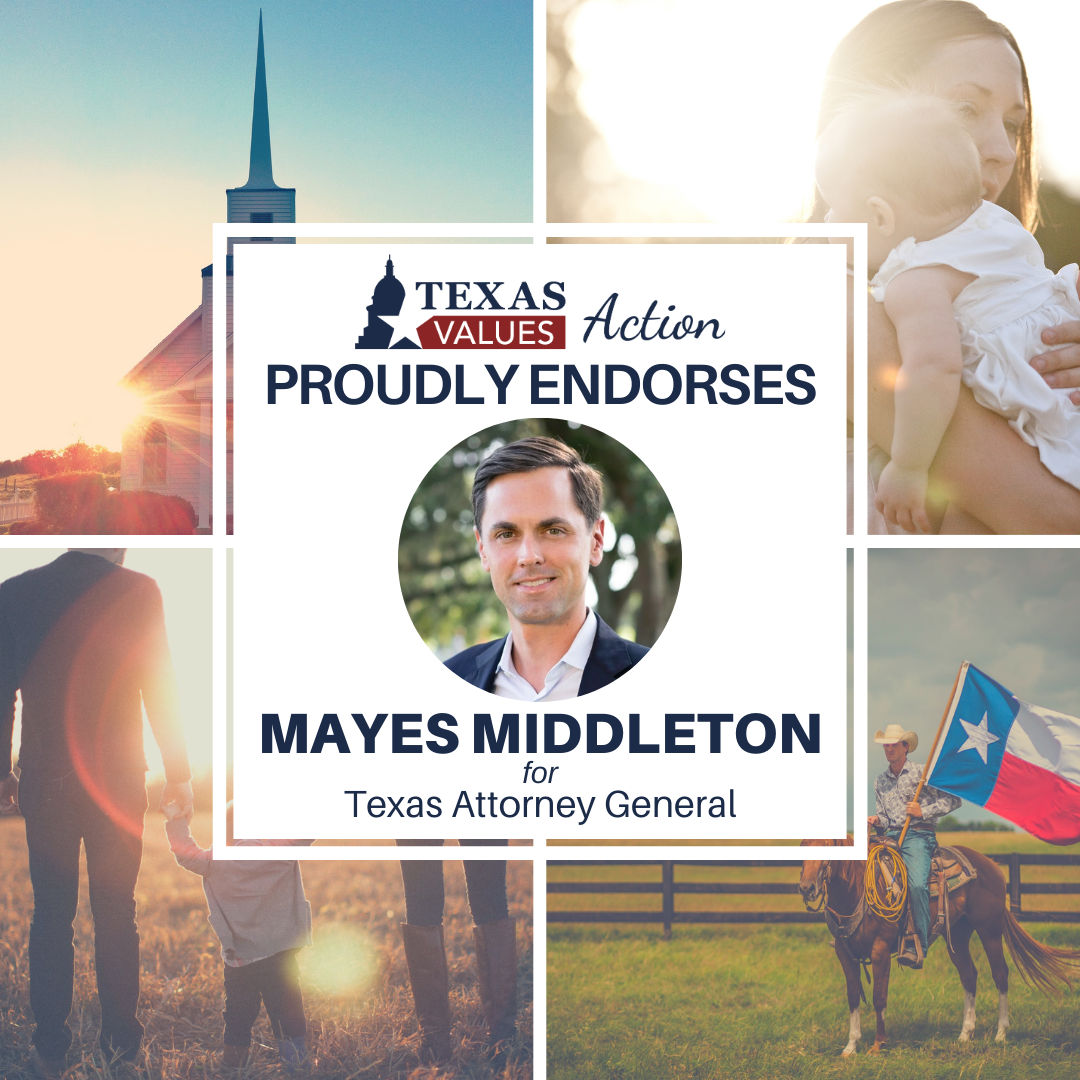
Recent claims in an article by The Federalist assert that Senator Mayes Middleton’s SB 854 from the 2025 Texas Legislative Session was filed to “require Texas municipalities to approve developments such as the proposed EPIC City,” or even to “force towns to greenlight Muslim ‘Sharia’ cities.” Also, supporters of Congressman Chip Roy have used this article to publicly criticize Senator Mayes Middleton in an attempt to convince Texas voters that Senator Middleton supports “Sharia cities” and/or is inexperienced in legal matters. Congressman Chip Roy and Senator Mayes Middleton are both candidates for the Texas Attorney General elective office in the upcoming runoff election for the Republican Party of Texas taking place on May 18, 2026.
A closer look at the law, court decisions, the activities during the 2025 Texas Legislative Session, and the United States Constitution shows this claim about Mayes Middleton related to SB 854 is wholly without merit. Please note that SB 854 is a bill that did not pass in the 2025 Texas Legislative session. SB 854 passed out of committee in the Texas Senate but was never voted on by the full Senate. Properly understood, SB 854 would not apply to for-profit developments like EPIC City, could not override constitutional constraints, and does not create any entitlement to land-use approval. Moreover, the broader legislative context confirms that such an interpretation is inconsistent with both the structure and purpose of the legislation, and the public and legislative activity, leadership and track record of Senator Mayes Middleton.
- SB 854 Does Not Apply to Developments Like EPIC City
The threshold issue is whether SB 854 would apply to a development such as EPIC City (East Plano Islamic Center) at all. It would not. SB 854 was a bill backed by numerous Christian churches and conservative organizations and individuals, and was about housing shortage issues and the fact that “many religious organizations own underutilized land, such as vacant lots and parking areas, that could be repurposed to provide much-needed housing, per the Texas Legislature’s website.”
SB 854 is what is often called a “Yes In God’s Backyard” (YIGBY) bill, and similar religious freedom bills of this type have been passed in other states, including Florida in 2025. SB 854 would be used to increase housing options for people such as schoolteachers, clergy and church staff, and veterans – groups of people that often face challenges due to high housing costs, often near where they work.
The statute incorporates definitions from Texas Civil Practice and Remedies Code § 110.011, which limits its protections to “religious organizations.” That definition is tied to entities that qualify for federal income tax exemption under Section 501(c)(3) of the Internal Revenue Code, or that would qualify but for limited exclusions. See Tex. Civ. Prac. & Rem. Code § 110.011.
This statutory framework excludes entities engaged in substantial commercial activity or organized or structured for a private financial for-profit benefit, like EPIC City. So, what is EPIC City? A recent lawsuit filed by the Texas Attorney General’s office to stop EPIC City, linked here, describes it like this:
“Community Capital Partners LP (“CCP”) is a Texas limited partnership created by the East Plano Islamic Center (“EPIC”) as a vehicle to acquire a 402-acre tract of land in Hunt and Collin Counties, with the aim of developing a planned community project dubbed “EPIC City.” As envisioned, EPIC City would, when built, host more than 1,000 residential lots, a private school, commercial and retail centers, and a masjid.” See Page 2 of the lawsuit linked above.
A development entity such as EPIC City, planned by Community Capital Partners and structured to acquire, finance, and develop real estate through investor participation—would not qualify for 501(c)(3) status because it serves private economic interests rather than exclusively religious or charitable purposes.
This limitation aligns with federal law, particularly the Religious Land Use and Institutionalized Persons Act (“RLUIPA”), which protects religious exercise rather than general land development. As summarized in the leading survey of the statute, RLUIPA applies to land-use regulations that impose a “substantial burden” on religious exercise—not to ordinary property ownership or development activity. See Validity, Construction, and Operation of Religious Land Use and Institutionalized Persons Act of 2000 (42 U.S.C.A. §§ 2000cc et seq.), 181 A.L.R. Fed. 247 (2002).
Courts applying RLUIPA have consistently required a direct nexus between the land use and actual religious exercises, and have rejected attempts to extend religious land-use protections to activities that are fundamentally commercial or secular in nature.
Although the development entity is affiliated with a nonprofit religious organization, that structural affiliation does not convert a large-scale, master-planned, investor-funded real estate development into protected religious exercise for purposes of SB 854.
- Constitutional Principles Foreclose Any “Sharia City” Theory
Even if SB 854 could be stretched beyond its statutory limits and for purposes not intended by the bill itself and the legislators supporting it, the claim that it would “require” or “force towns to greenlight Muslim Sharia cities” is foreclosed by the Constitution.
The Supremacy Clause establishes that the Constitution and federal law are the “Supreme Law of the Land,” binding on all state and local governments. Cooper v. Aaron, 358 U.S. 1, 18 (1958). No municipality, and certainly no private development, may adopt or enforce a legal system that supersedes or displaces governing law. Also, the Establishment Clause independently prohibits the government from establishing or endorsing a religious legal regime.
Thus, even under the most expansive hypothetical reading, no land-use statute could constitutionally authorize or require the creation of a parallel religious legal system. The claim is not merely exaggerated; it is legally foreclosed as a matter of constitutional law.
III. Religious Land-Use Protections Do Not Create a Right to Develop Commercial For-Profit Property
The assertion that SB 854 could “force” municipalities to approve for-profit development projects reflects a misunderstanding of how religious land-use protections function.
Statutes such as RLUIPA—and analogous state provisions—do not grant a right to build or develop for-profit property. Rather, they prohibit the government from imposing a “substantial burden” on religious exercise. This is a demanding standard that requires a showing of direct and meaningful interference with protected religious activity.
Accordingly, even if SB 854 were applicable—which it is not in the case of a for-profit development—it would not require a city to approve a large-scale project, like EPIC City.
- Legislative Context Confirms the Absence of Any “Greenlight” Intent
The broader legislative context further undermines the claim that SB 854 was intended to enable developments such as “Sharia cities.” Contemporaneous summaries and policy discussions reflect that SB 854 existed within a larger legislative framework advanced by Senator Mayes Middleton and allied policymakers aimed at reinforcing the primacy of Texas law and preventing the emergence of parallel or foreign-influenced legal systems.
For example, Senator Middleton supported SB 17, legislation restricting certain foreign ownership of real property in Texas, reflecting a policy priority of limiting external influence over land and infrastructure within the state. He also supported HB 4211, which was described as imposing additional safeguards against the development of communities operating outside traditional legal frameworks, including concerns about so-called “Sharia cities.” These measures were not in tension with SB 854 but instead operated alongside it, addressing distinct aspects of land use, ownership, and governance. In addition, Senator Middleton supported Governor Abbott’s 2025 directive designating organizations such as the Muslim Brotherhood and CAIR as entities of concern.
When considered together, SB 854, SB 17, HB 4211, and related executive actions reflect a consistent legislative approach: protecting religious liberty within constitutional bounds while ensuring that Texas law remains the controlling legal authority. The suggestion that SB 854 was intended to produce the opposite result—to compel approval of developments operating outside that framework—is not supported by the statutory text, case law, public statements or the legislative record.
Other Claims:
The claim has also been made the word “mosque” was removed from the author’s intent statement but that the bill language itself did not change. Just to be clear, the word “mosque” does not appear in the bill language, it simply appears in the initial document added online titled the “Author’s/Sponsor’s Statement of Intent” as part of a list of examples of religious structures including churches and synagogues. A mosque is a building that, if tied to a nonprofit religious organization, is included in the typical constitutional and religious freedom protections that a church or synagogue would receive. Simply referencing “mosque” in a description of examples of what nonprofit religious structures could receive protection under this proposed law is a matter of fact and current law, it is not anything new. And the fact that it did not appear in the updated version of the author’s intent statement is of no consequence. If there was any inference to be made, it would be that perhaps the word “mosque” was left out so that the word didn’t become a distraction (like it has here) during a time period when there was increased attention on the EPIC City issue in 2025. Either way, it is irrelevant to the way the law would work or be applied.
Conclusion
The claim that SB 854 was a tool to “force towns to greenlight Muslim ‘Sharia’ cities” as stated in The Federalist article, or even that the bill could be used for such a purpose even if that was not the intended consequence, fails at every level of analysis. The statute does not apply to for-profit development entities like EPIC City, constitutional principles prohibit the creation of any alternative legal system, and religious land-use protections do not create for-profit development rights or override zoning authority.
In light of these considerations, the argument is not simply weak—it is false and should be seen as pure political spin.
Lastly, there was one claim that the “only reason the bill didn’t pass is because the calendars committee didn’t get to it in time.” SB 854 only had movement in the Texas Senate and that movement ended in late March of 2025, with several months and time left in the legislative session. SB 854 was never passed to the House for consideration. The Texas House has a Calendars Committee. There is no Calendars Committee in the Texas Senate. If there are any matters of law and policy in Texas, particularly on issues of religious freedom, please do not hesitate to contact our office for expert insight and knowledge you can trust. And click this link to see the many other reasons that Texas Values Action has endorsed Mayes Middleton for Texas Attorney General in the upcoming Republican Run-off elections starting on May 18th.
Jonathan Saenz
President & Attorney
Texas Values Action
Jonathan Covey
Director of Policy
Texas Values Action